¶ Dispensing — Assemble a Prescription
¶ What you'll be able to do
After reading this guide you will be able to record what is being supplied for each item on a prescription the
pharmacy has claimed, so that the prescription can go forward for the pharmacist's accuracy check.
Who does this? Assembly is done by the Responsible Pharmacist or the Dispensing Technician — both
work the dispensary. If you cannot see Dispensary in the top menu, your login does not hold one of those
two roles; that is a permission setting, not something you can change yourself.
¶ Why assembly is a step of its own
Claiming a prescription takes responsibility for it (see
Dispensing — Claim a Prescription). Assembly is the next
step, and it answers a different question: what is actually being supplied.
The prescribing information comes from the spine — the medicine, and the quantity the prescriber asked for.
Assembly records what is being handed out from the pharmacy's own shelf against each of those lines. The
prescription then carries both: what was prescribed, and what is being supplied, item by item.
Two things follow from that, and they explain how the screen behaves:
- The prescription is not changed here. The items on the assembly screen are the items the prescription
arrived with. You record quantities against them — you do not add, remove or change a medicine. - It is all or nothing. Every item is on one screen, with one Record assembly button, so a prescription
either has its assembly recorded or it does not. There is no half-assembled state.
¶ Before you start
- The prescription must be claimed, and showing the state Claimed — that is the only state assembly is
offered from. If it has already been assembled the app will refuse, and nothing will be recorded. - Your login must hold the Responsible Pharmacist or Dispensing Technician role (see above).
- Know what is being supplied for each line before you start: the screen asks for a quantity, and records it
against your name.
¶ Step 1: Open the prescription
- Log in to the pharmacy app.
- Click Dispensary in the top menu.
- Under In progress, find the prescription and click Open.
Each row of In progress shows the Token (the reference it was claimed by), the Patient, the
Status it is in, and the date it was Claimed.
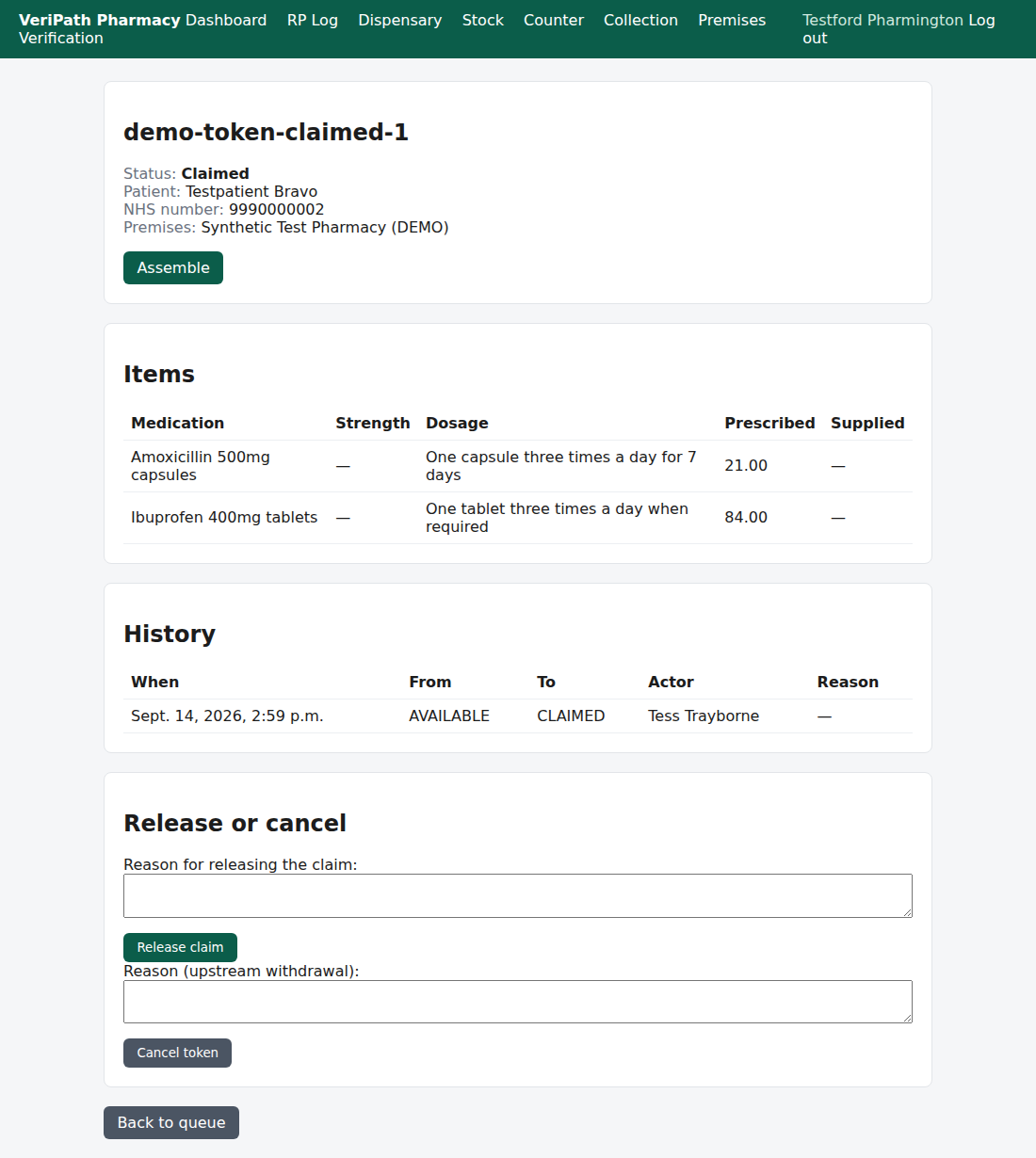
The prescription as it arrives at this step: the state reads Claimed, the prescribed items are listed with
the Supplied column still empty (—), and the actions for this state are offered — Assemble, and the
release and cancel actions.
¶ Step 2: Start the assembly
Click Assemble on the prescription.
The assembly screen opens with the prescription's items in a table:
| Column | What it tells you |
|---|---|
| Medication | The medicine, as the prescription names it. |
| Strength | The strength, where the prescription gives one. |
| Dosage | The instructions, as prescribed. |
| Prescribed | The quantity the prescriber asked for, where one is given. |
| Supplied | The box you fill in — the quantity being supplied for that line. |
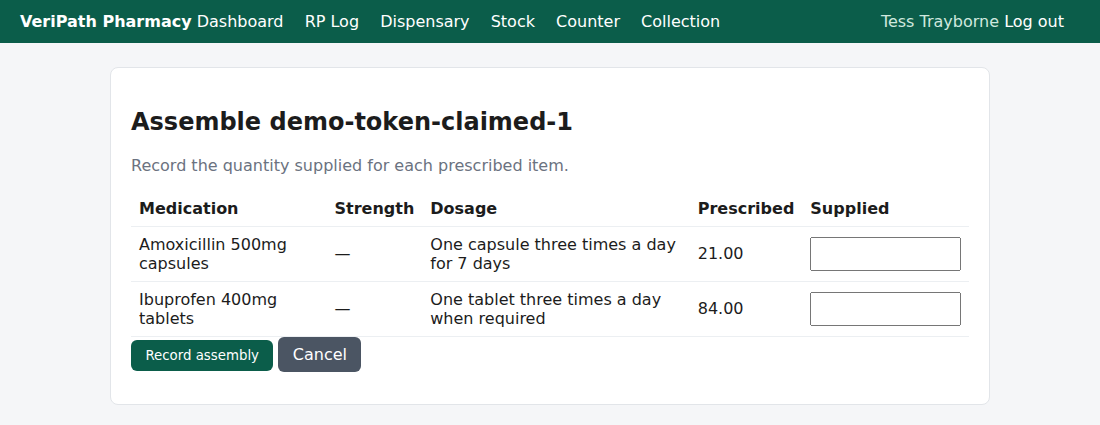
The assembly screen, here opened by a Dispensing Technician. Every item on the prescription is on one screen,
with a Supplied box on each line. Record assembly records the lot; Cancel returns you to the
prescription with nothing recorded.
¶ Step 3: Record the quantity supplied
- Type the quantity being supplied into the Supplied box for each item. Whole quantities and decimals are
both accepted —21and7.5are recorded exactly as typed. - Check your entries against what you are actually supplying.
- Click Record assembly.
- The app records the assembly, moves the prescription forward, and returns you to the prescription's own page
with a green banner: "Assembly recorded."
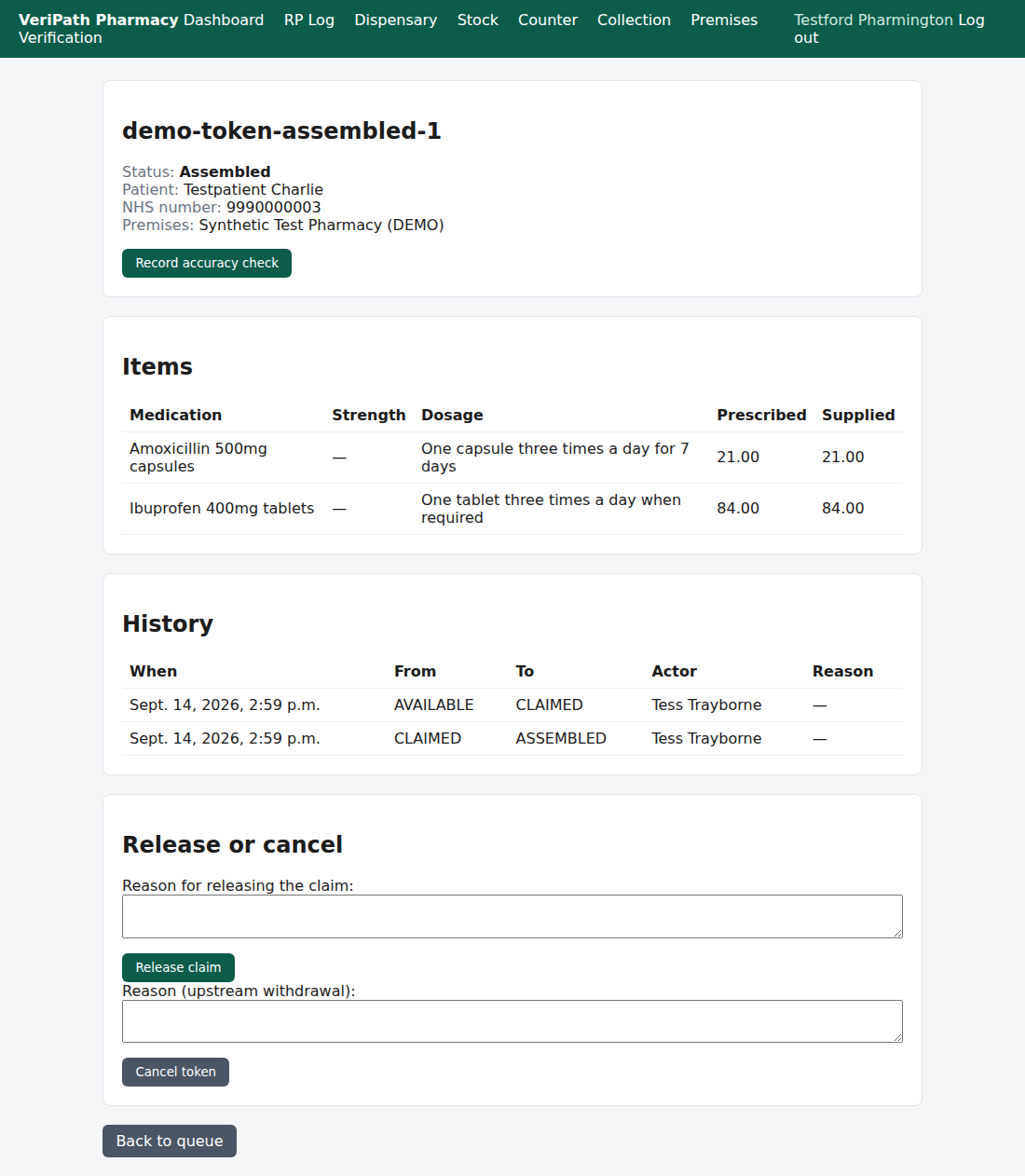
After assembly: the state reads Assembled, every item now shows the quantity supplied, and the History
has gained the step from CLAIMED to ASSEMBLED, with the name of the person who assembled it.
Nothing is written until the button is pressed. If you click Cancel, or navigate away, the prescription
stays Claimed and the assembly screen can be opened again.
If a line is not being supplied, leave its Supplied box empty. The app accepts an assembly with a box
left blank, and that item then shows as —, as it did before. Leaving a box empty records no quantity — it
does not record a quantity of zero.
¶ Step 4: What happens next
On the prescription's own page the state now reads Assembled, and what you are offered depends on your role:
- Record accuracy check — the pharmacist only. The check is done against what has just been assembled, so
it cannot be recorded before the quantities are (see The Accuracy Check, B3). - Release claim / Cancel token — still available while the prescription has not been dispensed (see
Release or Cancel a Claim, B6).
A Dispensing Technician sees the assembly through, but is never offered the accuracy check, the dispense or the
endorsement.
¶ If it doesn't work
| What you see | What it means |
|---|---|
| "Quantity supplied cannot be negative." beside the box | A minus figure is not a quantity. The screen stays open with your other entries still in place — correct the box and record again. |
| "Enter a number." beside the box | The box holds something that is not a figure. |
| "assemble requires the token to be CLAIMED (it is ASSEMBLED)." | The prescription has already been assembled — by someone else, or while your copy of the page was open. Nothing was recorded. Open the prescription and read History to see who did what. |
| No Assemble button on the prescription | Either the prescription is not in the state Claimed, or your login is not a pharmacist's or a technician's. |
| You are taken to the premises screen | The pharmacy has no premises profile yet. That is completed once, at setup — speak to your Business Manager. |
Because only Record assembly writes anything, a refused or abandoned assembly needs no tidying up.
¶ What the record keeps
Every step appends a row to the prescription's History: the time, the state it moved from and to, who
did it (a name recorded at the time, so a later change of name does not rewrite history) and the reason, where
one was given. An assembly records no reason of its own — the quantities are the record.
Two details worth knowing:
- Assembly does not move stock. The quantities recorded here are what is being supplied; the stock ledger is
touched later, when the prescription is dispensed. - Assembler and checker are recorded separately. The record keeps the two steps and who did each, and the
app does not prevent the same person recording both.
The audit trail records the action and the person — not the clinical content.
¶ Related
- Dispensing — Claim a Prescription — the step before
this one - Coverage Plan — the guides and what is left to write
- The Accuracy Check — the next step, pharmacist only (B3)
- Release or Cancel a Claim — handing a prescription back (B6)
- Roles and Permissions in the Pharmacy App — who can
reach the dispensary