¶ Plaque & Bleeding Indices
¶ What you'll be able to do
After reading this guide you will understand how VeriPath Dental records the two key periodontal indices — the plaque index and the bleeding on probing (BOP) index — as percentage scores for a patient's mouth. You will learn what each score means, how the scores are calculated automatically from the six-point tooth records (there are no boxes to type a percentage into), where the tick-boxes live, and where the finished scores appear so you can track a patient's gum health over time.
Who does this? Dentists and dental hygienists record plaque and bleeding flags while they chart a periodontal exam. Practice managers and dental admins can view the scores. Receptionists do not see Periodontal in their menu and cannot open the screens — periodontal data is clinical.
Related guide: the two indices are recorded on the same exam as the 6-point pocket depths. See Periodontal Charting (6-Point Probe) for the full charting workflow — this page focuses on the two scores themselves.
¶ About the two indices
Both indices are shown as an overall percentage (0–100%) for the mouth. Each one is derived from the flags you tick while charting teeth: at every probe site you record whether plaque is present and whether the site bled on gentle probing, and the app counts the results for you.
| Index | What it measures | How it is calculated |
|---|---|---|
| Plaque score | How much of the tooth surfaces carry visible plaque | The percentage of charted probe sites where you ticked Plaque |
| Bleeding on probing (BOP) score | How many gum pockets bleed when gently probed | The percentage of charted probe sites where you ticked Bleeding on probing |
A lower score is better. Rising scores between visits are an early warning that plaque control or gum inflammation is getting worse, so the two numbers are tracked over time as an indicator of periodontal health.
¶ Step 1: Open the Periodontal screen
- Log in to VeriPath Dental with a clinical role (Dentist or Dental Hygienist).
- Click Periodontal in the top navigation bar.
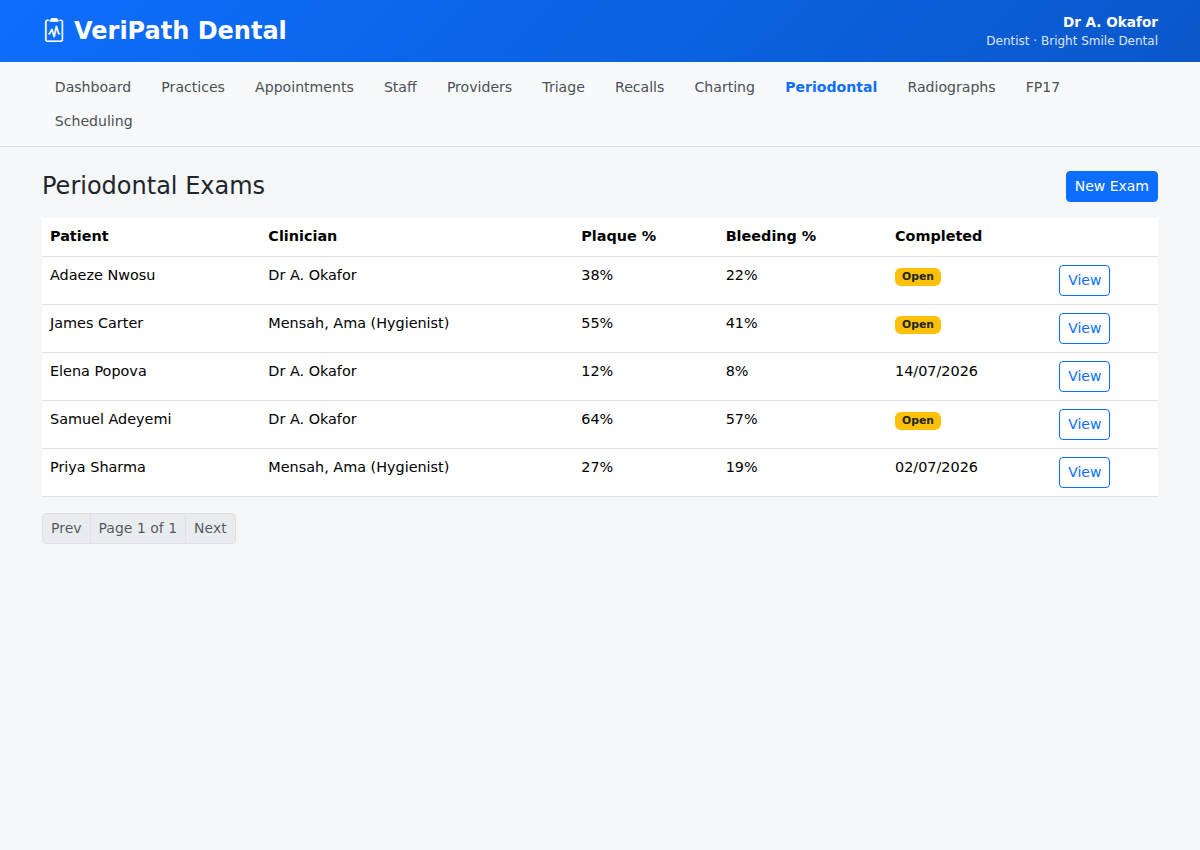
The Periodontal Exams list shows one row per exam. The Plaque % and Bleeding % columns give you the two index scores for each exam at a glance — so you can see a patient's progression across visits.
| Column | What it shows |
|---|---|
| Plaque % | The overall plaque index for the mouth (0–100%) |
| Bleeding % | The overall bleeding-on-probing index (0–100%) |
| Completed | The completion date, or an Open badge if still in progress |
Both columns are calculated automatically from the charted teeth — they are never typed in. A brand-new exam with no charted teeth shows 0% in both.
¶ Step 2: Start an exam — there are no score boxes
- Filter to the patient (see Periodontal Charting (6-Point Probe)) and click New Exam.
- Choose the Appointment the exam was performed at, add a Clinical Summary if you like, and click Create Exam.
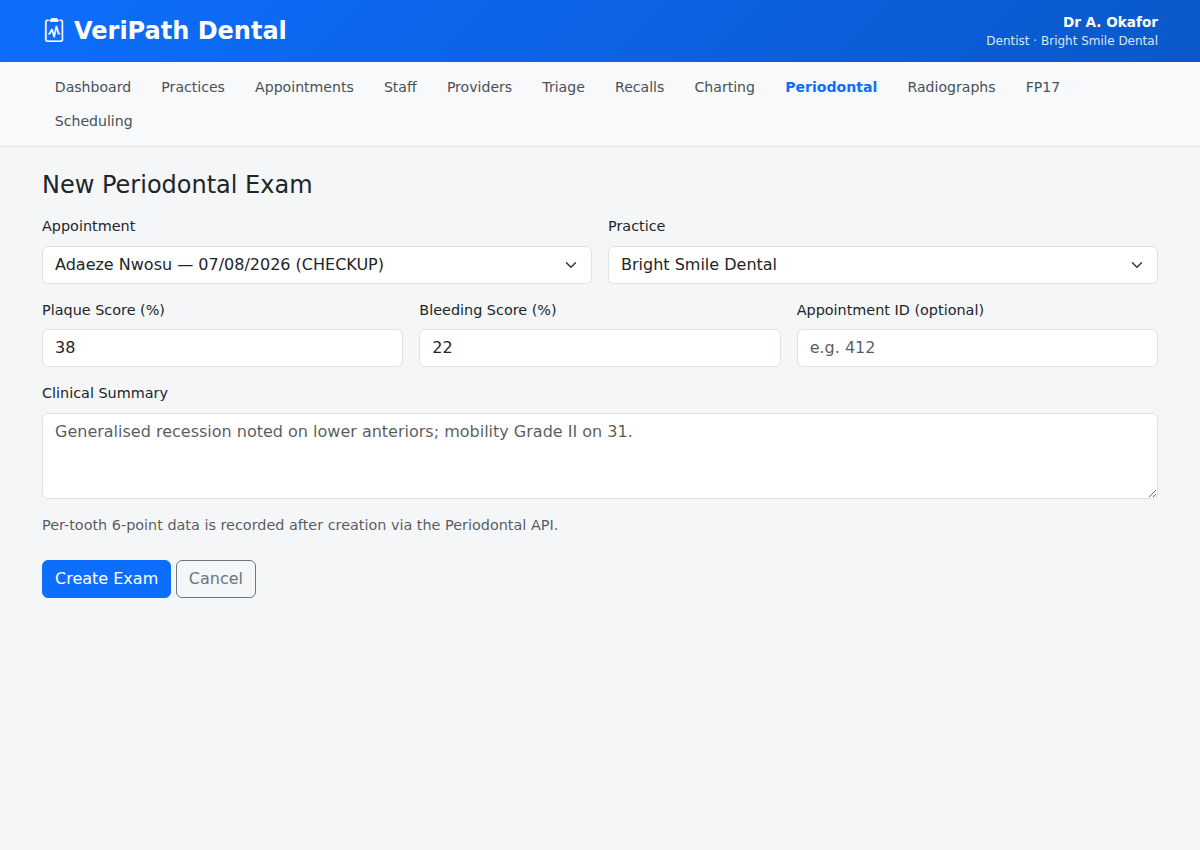
Notice what the form does not have: no Plaque Score (%) or Bleeding Score (%) fields. The form explains why:
"Plaque % and bleeding-on-probing % are computed automatically from the per-tooth 6-point records once teeth are charted on the exam — a new exam shows 0% until teeth are charted."
So the exam starts at Plaque 0% / Bleeding 0%, and the scores only begin to move once you chart teeth.
¶ Step 3: Record plaque and bleeding at each probe site
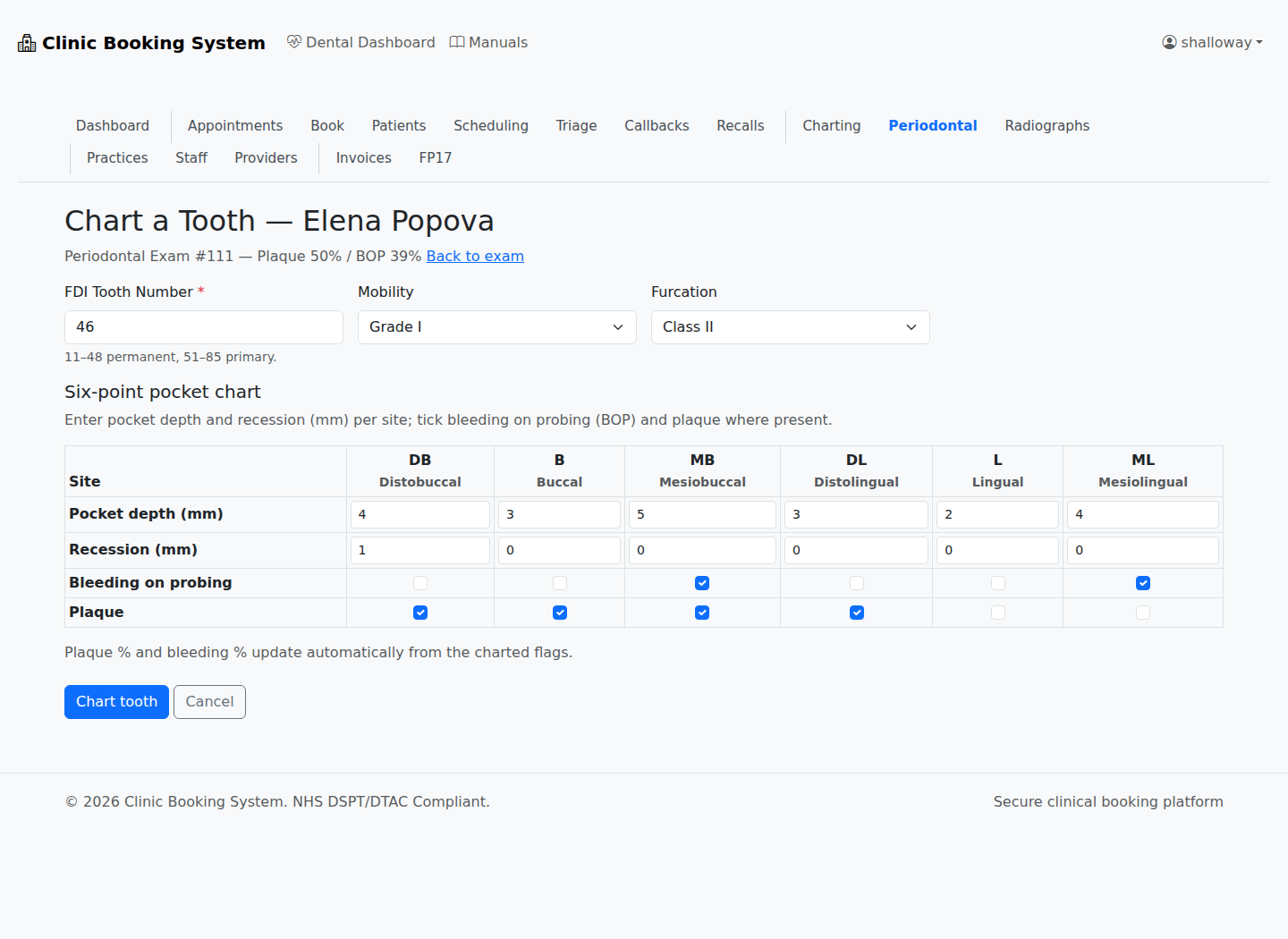
The two indices are built from the flags you tick in the Six-point pocket chart while charting each tooth. Every tooth is measured at six sites (db, b, mb on the cheek side; dl, l, ml on the tongue side), and for each site you record:
- Pocket depth (mm) and Recession (mm) — the measurements (covered in the charting and recession guides).
- Bleeding on probing — tick the site if it bled when probed.
- Plaque — tick the site if visible plaque is present.
- On the exam detail page, click Add tooth.
- Enter the tooth and its readings (see Periodontal Charting (6-Point Probe) for the full steps).
- Work down the Bleeding on probing row, ticking each site that bled.
- Work down the Plaque row, ticking each site with visible plaque.
- Click Chart tooth.
The tooth is saved and the exam's Plaque % and Bleeding % are recalculated immediately from everything charted so far:
- Plaque % = the number of sites ticked for plaque ÷ the total number of charted probe sites, × 100.
- Bleeding % = the number of sites ticked for bleeding on probing ÷ the total number of charted probe sites, × 100.
Every tooth you add, edit or delete recalculates both scores, so they always reflect the current chart.
Tip: be consistent about which sites you score — the standard is all six probe points of every tooth you chart. The calculation counts every charted site equally, so the more complete the chart, the more representative the score.
¶ Step 4: Review the scores on the exam
The exam detail page shows both indices at the top, next to the completion status, and each charted tooth's own flags beneath:
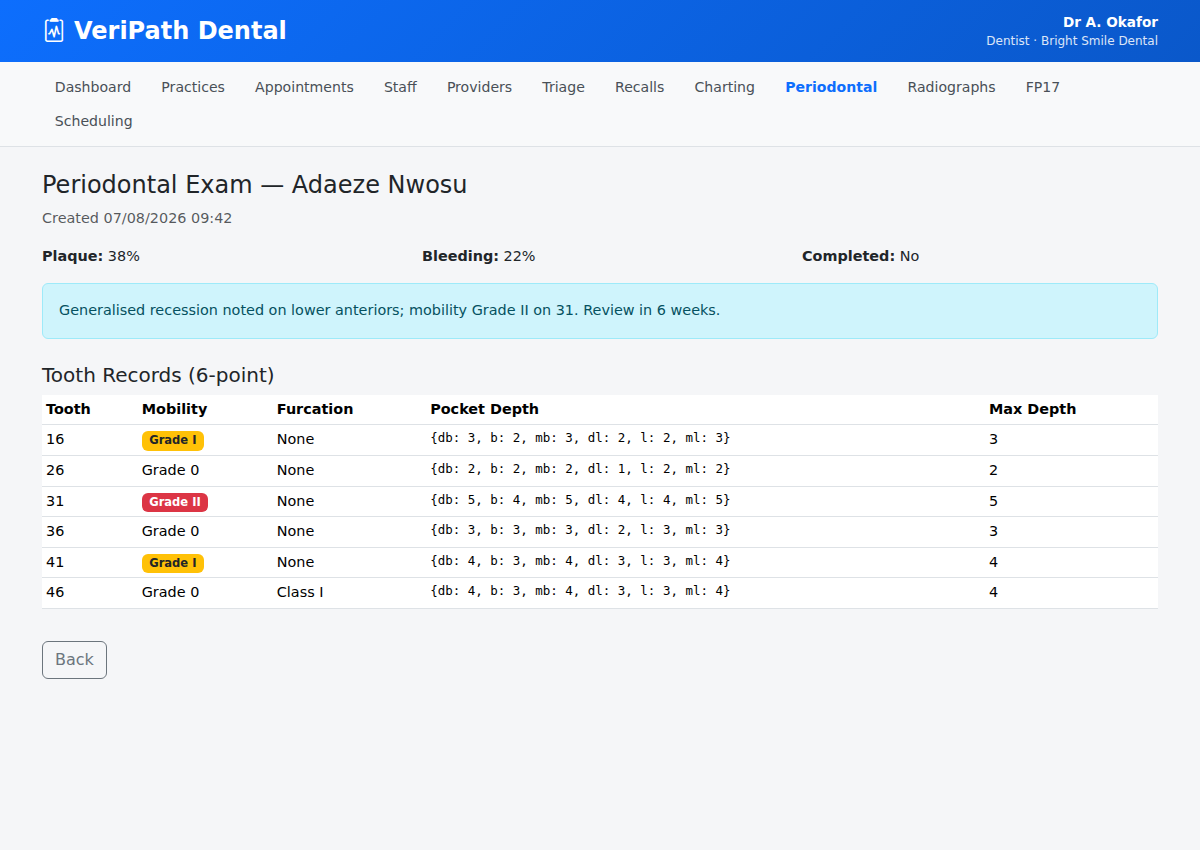
- Plaque — the overall plaque index percentage.
- Bleeding — the overall bleeding-on-probing percentage.
- BOP sites / Plaque sites (one column each in the tooth records table) — which of that tooth's sites were flagged, e.g.
DL MB ML, so you can see where the plaque and bleeding are, not just the headline percentage. - Completed — the completion date, or an Open badge if still in progress.
The two overalls are read-only everywhere in the app — they cannot be overwritten by hand, which keeps the record consistent with the underlying tooth data.
¶ Step 5: Finish the exam
When the chart is complete, click the green Complete exam button. The exam is stamped with the completion date and the name of the person who completed it, and the record is signed off and locked: the scores are frozen as the finished record and the tooth controls disappear.
When are the plaque and bleeding indices done? The indices are recorded as part of the full 6-point exam, which is taken at the visit where it is clinically indicated — for example at a check-up where the basic screening exam (BPE) flags deeper pockets, at active-periodontal (gum disease) review or maintenance visits, or before and after periodontal treatment to record the baseline and the outcome. VeriPath Dental records the 6-point exam and derives the indices from it; the quick BPE screening that decides when a full chart is needed is recorded outside the app.
¶ Useful tips
- Tick as you probe — record the bleeding and plaque flags at the same time as the depths, site by site, so nothing is left to memory.
- Probe gently and consistently — light, controlled pressure keeps both the depths and the BOP flags accurate and comparable between visits.
- Track the trend, not the single visit — a rising or falling percentage across exams is what tells you whether gum health is improving.
- A 0% exam means "nothing charted yet", not "perfect" — the scores only count sites you have charted.
- Scores are a screening aid — combine them with the pocket depths and your clinical examination.